-
The Golden Pheasant Inn
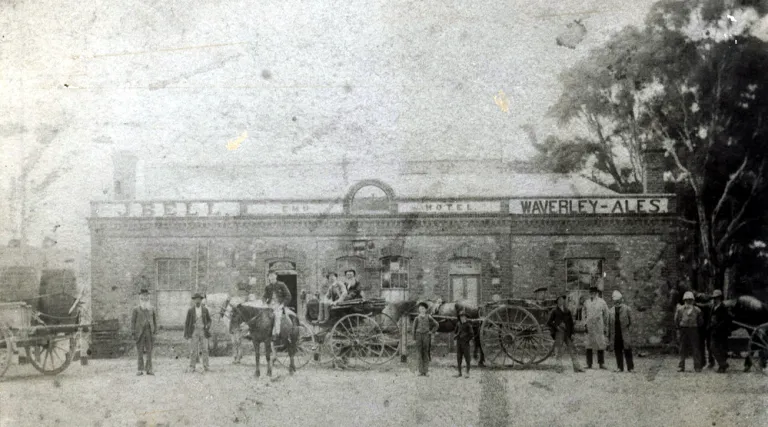
Built by William Holly in 1841, the Golden Pheasant served whalers, travellers, and farmers at Hackham for more than thirty years before being left to decay beside the Main South Road.
Read more... -
St Philip and St James Church
Built of ironstone hauled from the Onkaparinga River cliffs in 1850, St Philip and St James Anglican Church still stands on the hill above the old Noarlunga township.
Read more... -
David Beyer and Karlsruhe Farm
A German carpenter who first tried his luck in New Zealand arrived at Port Adelaide in 1844 on the Joseph Albino, raised a family on the Seaford coast, and served three terms as Chairman of the District Council of Noarlunga.
Read more... -
The Almanda Silver Mine
South Australia's only silver rush erupted in 1868 around a failed copper mine in the hills above Scott Creek, on land that had belonged to one of the district's earliest settler families since 1838.
Read more... -
Landcross Farm
A Devon village name carried to McLaren Vale by John Gribble in the 1850s, Landcross Farm passed through three families across nearly 150 years before its final sale in 1997.
Read more... -
The Clarendon Vineyard
From a Spanish vine collection on a hilltop above Clarendon to gold medals in European shows, the Clarendon Vineyard was one of colonial South Australia's most celebrated wineries.
Read more... -
The Bilney Homestead, Kangarilla
A Norfolk family who arrived on the Duke of Wellington in 1840 put down roots at Kangarilla and farmed the same hillside for four generations.
Read more... -
Murray's Biscuit Factory
Alexander Murray arrived in South Australia in 1840 and built his biscuit factory into a Coromandel Valley hillside, producing biscuits and jams for sixty years that found markets across the colonies and praise at international exhibitions.
Read more... -
White's Flour Mill, Aldinga
From a tower beside his flour mill, Samuel White could signal passing ships by semaphore and receive back the current price of flour in Melbourne before anyone else in the district knew it; by 1867 he was insolvent and bound for New Zealand, and the mill closed a decade later.
Read more... -
Alton Guest House, Port Willunga
Mildred Constance Dunstan's clifftop guest house at Port Willunga ran for nearly fifty years from 1907, drawing Adelaide families to the dunes above the Gulf.
Read more... -
The Doctor's House
Built in 1866 and large enough to earn the nickname Folly Hall, the stone house at the corner of Main South Road and Doctor's Road at Hackham became home to a succession of district doctors — including one who never made it back to it.
Read more... -
Samuel Reynell
Samuel Reynell arrived in South Australia in 1838 under his cousin John's reluctant guardianship, with a fine education and no practical skills. His story runs from colonial ruin to a quiet respectability the obituary writers thought it wise to leave unqualified.
Read more... -
The Old Cave, Reynella
The oldest surviving wine cellar in Australia is a grass-covered mound at Reynella, dug by hand into limestone in 1845. John Reynell built it the year after his first vintage; it outlasted his family, several corporate owners, and nearly 180 years of South Australian summers.
Read more... -
The Three Rifles Monument
The Three Rifles Monument at O'Halloran Hill — now part of Keane War Memorial Gardens — was built on land donated by a family that had already given a son to the war, and spent twenty-six years without its defining feature after the replacement rifles were stolen.
Read more... -
The Crown Inn, Reynella
Built in 1854 on land sold by John Reynell to his first publican, the Crown Inn was the only hotel in Reynella for most of the colonial period — a two-storey stone building that served as polling place, inquest room, coaching stop, and social centre for the district. It is still standing on Old South Road.
Read more... -
The Tintara Vineyard Company
Before Thomas Hardy made Tintara a household name, the winery was a Scottish physician's ambitious gamble — seven hundred acres of McLaren Vale scrub, backed by the colony's wealthiest men, and doomed by a market that wasn't ready.
Read more... -
The Tally-Ho Hotel
Clarendon's first hotel stood on the bank of the Onkaparinga, its back door a few paces from the only ford in the valley. When the river flooded, travellers sheltered under its thatched roof and waited.
Read more... -
Clarendon Bridge
In 1858 a young woman broke a champagne bottle against the new timber bridge at Clarendon, naming it for the village below. The ford it replaced had tested every cart and carrier on the road south for twenty years. Sixty years later the timber was rotting — the ford pressed into service one last time before a concrete arch took its place.
Read more... -
United States Vale
A cluster of allotment settlers on Bains Road in Morphett Vale called their community 'United States' in the 1840s — a name whose origins remain unexplained. The man who subdivided the land had already sailed back to England before the name appeared; the settlers who stayed built a Union Chapel and gave the district a reminder that survives today in States Road.
Read more... -
Gloucester and Bellevue
Before McLaren Vale had a name, two separate townships occupied the same stretch of road — Gloucester at the southern end, Bellevue to the north. The man who opened Gloucester's first hotel died before the day was out. The man who laid out Bellevue's streets died the following year. What they built became one of Australia's most celebrated wine towns.
Read more... -
The Happy Valley Congregational Church
The first Congregational chapel at Happy Valley stood on the site of the reservoir; when the dam was built in the 1890s, twenty-four graves were relocated and the village disappeared under the water. The 1856 building on the opposite side of the road survived — sustained for decades by lay preachers, the Mason family, and a congregation that outlasted the town it once served.
Read more... -
The Victoria Hotel, Tapley's Hill
The Victoria Hotel at the top of Tapley's Hill has stood on the main road south from Adelaide for over a century — from Thomas Tapley's first licence in 1844 through sixteen publicans, a major earthquake, a cycling trophy, and a long life as the social centre of the district.
Read more... -
Thomas Tapley of Tapley's Hill
The hill on the road south from Adelaide carries the name of Thomas Tapley, a Kentish man who arrived in 1838 and planted his family on its summit — founding the hotel and farm that would outlast him by a century.
Read more... -
The Easter Camp at Happy Valley, 1911
In April 1911, fifteen hundred infantry and Light Horse assembled at Happy Valley for the annual Easter training camp — marching south past the Victoria Hotel at Tapley's Hill before a week of manoeuvres, sham fights, and heliograph practice in the hills.
Read more... -
Victoria School, Morphett Vale
Named after a school in a Scottish fishing village where Queen Victoria had passed on her first visit to Scotland, a small building stood near Christie Creek for a quarter century — as much a community hall for Morphett Vale's social life as a classroom.
Read more... -
The Union Chapel, Morphett Vale
The first Protestant place of worship in Morphett Vale, the Union Chapel opened in 1850 and served its Congregationalist congregation for barely twenty years before losing its flock to the new Baptist church down the road. Thomas Hardy bought the neglected building for fifty pounds in 1889 and turned it into a wine cellar.
Read more... -
Emu Wines, Morphett Vale
The winery that stood on Wheatsheaf Road at Morphett Vale had a history that stretched back nearly a century before the buildings came down in 1989. It had begun not as a winery at all but as a London importing house — built by a Scottish vigneron from Magill, that put an emu on its label in 1883.
Read more... -
Glenheath Farm
Glenheath Farm at Lonsdale passed through three families in its first half-century: the Kings from Cornwall who broke the ground and built the homestead, the McClouds who gave the farm its name, and the Listons from Parkside — former accountant Henry Liston had stood at Ballarat during the Eureka Stockade — who rebuilt the house, planted almonds and vines, and stayed.
Read more... -
The O'Sullivan Family of Morphett Vale
Ignatius O'Sullivan brought his wife Honora and five children to Morphett Vale on the Mary Dugdale in 1840, settling near Christie Creek in what is now industrial Lonsdale. His son Thomas went twice to the Victorian goldfields in 1852, farmed in partnership with his father for fifteen years, and eventually built a stone homestead called Belle Vue. Thomas farmed the same land for seventy years and went blind in old age, cared for by his daughter Lillian May — who married Frank Higgins.
Read more... -
Sauerbier Family
Christian Johann Sauerbier arrived in South Australia around 1840 and spent the next five decades building one of the largest private landholdings in the Happy Valley district — farming, growing vines, sitting on the district council, and fighting the government over the price of land it took to build a reservoir. His sons scattered: one to the Kimberleys, one to the McLaren Flat sheep country. The eldest, when the war came, quietly changed his name. A suburb is named for the one he chose.
Read more... -
Mount Malvern Silver Lead Mine
A silver and lead mine on Partridge's property in the hills between Blackwood and Cherry Gardens operated in two bursts — the 1890s, when an on-site smelter collapsed and the price of silver fell, and again from around 1906 until the First World War. Harvey's Shaft, sunk to more than 300 feet, still survives at the site.
Read more... -
Colonnades Shopping Centre
When the Colonnades opened on 2 October 1979, it was the first large shopping centre in Adelaide's southern suburbs — built as the commercial anchor of a planned regional hub that the Dunstan government had been assembling for a decade. The name came from the roughly 640 concrete columns that held the place up.
Read more... -
Glenloth Winery and Distillery
Named after a Melbourne Cup winner and founded by an electrical engineer who introduced the first powered machinery to the district's cellars, Glenloth grew from a Horn family vineyard at Flagstaff Hill into one of the Southern Vales' most ambitious export operations — surviving the Depression through the determined London salesmanship of Elizabeth Robertson and eventually absorbing the ill-starred Tangari winery at Happy Valley.
Read more... -
Robert Bain and Melville Farm
Scottish immigrants James and Margaret Bain built Melville Farm — 320 acres bounded by Bains, States, Panalatinga and Pimpala Roads — soon after their arrival in 1839. James gave the land for the Bains Public Cemetery; his son Robert chaired the District Council of Morphett Vale through the 1860s, served as Elder of John Knox's Church, and died of an epileptic fit in 1876 at the age of forty-two. One stone barn, built in 1857 by the local mason Daniel Easton with a curved galvanised-iron roof and no internal supports, is almost all that remains of the property.
Read more... -
Morphett Vale Flax Mill
In July 1941 the State Premier announced that one of South Australia's four new Commonwealth flax mills would be built at Morphett Vale. Within twenty-one months it was being inspected by the Governor and its fifty employees had become the first establishment in the State to subscribe one hundred per cent to a War Loan. The manager, W. N. Ellis — formerly of the Berri Co-operative Winery — ran the operation through three shifts and a season of five months, with eighty-five young women on the floor and the Land Army's first intake in the field.
Read more... -
The Higgins Family of Morphett Vale
Patrick Higgins came out from Ireland in 1840 with the first threshing machine the colony had seen and was killed by it at the age of thirty-two. His son John kept the blacksmith's shop next to the Emu Hotel on Main South Road, Morphett Vale; John's son Frank kept it after him into the 1940s. By his seventies Frank had moved to a farm at Christies Beach, where he still hosted Adelaide schoolchildren to tell them where the district came from.
Read more... -
Swing Bridge, Noarlunga
For more than 150 years a slim suspension footbridge — locally always called a swing bridge — has carried walkers across the Onkaparinga River at Old Noarlunga. It has been built, swept away, and rebuilt five times. The first was washed off in 1867 with the tree it was anchored to. The second went down in the highest flood the town had ever seen, in 1883. The most recent fell in 2016.
Read more... -
Reynella Memorial Hall
The Reynella Community Centre on the corner of Old Main South Road and Reynell Road opened on 18 December 1954 — Premier Tom Playford in front of five hundred people, on land donated by Mrs Carew Reynell. Its WWI Roll of Honour names her husband and other local men killed in service; it has stood as the town's Memorial Hall ever since. May Reynell had buried three of her family across three wars and forty years: her husband at Gallipoli in 1915, her son in the Battle of Britain in 1940, her grandson in a helicopter accident in 1973.
Read more... -
Port Noarlunga
At the mouth of the Onkaparinga River, the small port that handled wheat and flour from inland Noarlunga in the 1850s and 1860s never grew the way its boosters predicted. The jetty, the tramway, and the sandhill tunnel went into decline by the 1880s, and only ten houses stood here in 1909. The 1920s discovered the place as a seaside holiday town, and built it most of what stands today.
Read more... -
Happy Valley
Edward Burgess gave the valley its English name within two years of stepping off the boat in 1837. For the next sixty years it was a small farming district inside the broader Hurtle Vale country — vines and wheat, a Congregational church, a school on Candy Road, the Bishop and Kenihan and Sauerbier and Candy families working the slopes. Then the reservoir came, drowned the township, and reshaped what remained.
Read more... -
Horseshoe Inn, Noarlunga
Licensed in July 1840, the Horseshoe Inn at the corner of the Onkaparinga's horseshoe bend was the first hotel in the southern districts. For nearly a century it served Cobb and Co. coaches, bullock teams bound for Willunga, magistrates, hunting parties, and election meetings; for fifty more it was a saddlery and a petrol station. Re-licensed in 1983, it was destroyed by fire on 1 January 1988.
Read more... -
Old Noarlunga and the Horseshoe
The South Australian Company laid out a township in 1840 inside the horseshoe bend of the Onkaparinga River, eighteen miles south of Adelaide. For four decades it was the commercial hub of the southern districts — a steam mill, two hotels, a brewery, six churches, a market square. Bypassed by the new south road in 1972 and renamed Old Noarlunga in 1978.
Read more... -
Reynella
John Reynell laid out the township on part of his farm in 1854, selling around ninety allotments for nearly £3,000. By 1867 the valley had a steam flour mill, a hotel, a school, and a Wesleyan chapel — and a population of roughly a thousand stretching from Morphett Vale to O'Halloran Hill. The town that grew from those allotments became one of the wine districts of the southern suburbs, its name the only one in the world shared by both a town and a registered wine brand.
Read more... -
O'Halloran Hill
The hill south of Adelaide that bore Major Thomas O'Halloran's name within two years of European settlement carries it still. From tents on the hillside in January 1839 to a farm of more than 800 acres with Governor Gawler at the dinner table, and on through a century of change — a remount farm, a military school, a fire that destroyed the main house but left the original Lizard Lodge standing.
Read more... -
Morphett Vale Public School
The Morphett Vale Public School opened in 1880 on a one-acre block at the corner of Main South Road and Beach Road, replacing the older Victoria School near Christie Creek. It served the villages of Morphett Vale and Hackham for nearly a century before the building became a library, a community centre, and eventually a funeral home.
Read more... -
Pingle Farm
John and Jane Jared arrived in the district in 1846, settled near Willunga, then obtained Section 322 in the Hundred of Noarlunga and built a stone farmhouse they called Clear Farm. Their son John William returned from Clare in 1879, expanded the building, served on the Noarlunga council, and married two sisters in succession. The property was still Clear Farm in 1892; at some later point it became Pingle Farm. The family held it for over a century. It is now a ruin inside the Onkaparinga River Recreation Park.
Read more... -
John Knox Free Presbyterian Church, Morphett Vale
James Benny arrived in South Australia in 1845 as a young Scottish lawyer who had witnessed the Disruption. He gave up the bar to become a minister, and in 1855 took charge of the John Knox Free Presbyterian Church on William Street, Morphett Vale — a Gothic freestone building raised by subscription at £1,100. The church was known in its early years as Anderson's Church, after the farming families who had been among its founders. Benny outlasted a church union and most of his congregation, and died in the manse in 1910, fifty-five years after his ministry began.
Read more... -
Hackham
A township surveyed in 1856 on land that three different people may have named, for three different reasons. By 1866 it had a hotel, a post office, and a daily coach to Adelaide. By the 1880s it had dwindled to gardens and wattle plantations. The hotel, built in 1841 by a man who arrived from England the year before, had already been closed for twenty years by then.
Read more... -
Dalkeith Farm
Andrew Harriott named his farm after his birthplace in Scotland and spent nearly two decades on the Noarlunga coast before the wreck of the Nashwauk made it notorious. He sent a man on horseback for help, hosted the dying captain, and bought most of the cargo at auction. The legend that grew from those facts — smugglers, signal lights, trained horses, vault-like cellars — was more vivid than the evidence.
Read more... -
Christ Church, O'Halloran Hill
Major Thomas O'Halloran arrived in South Australia in 1838 as a retired army officer, became the colony's first commissioner of police, and spent decades as the driving force behind the church he built for the settlers of Hurtle Vale, Happy Valley, and O'Halloran Hill. The government told him the neighbourhood was too thinly populated to justify funding. He built it anyway.
Read more... -
Archerfield
Peter Anderson left Scotland in 1839 with a letter of introduction from Sir James Fergusson of Archerfield to Governor Hindmarsh, selected a block beside Second Creek, and named it Burnside — giving the eastern suburb its name. He later moved south to Morphett Vale, where he named his new homestead Archerfield in honour of his benefactor. At his death he held over 1,100 acres across six named properties. His son confirmed the Burnside story to a newspaper in 1908.
Read more... -
Walter Reynell & Sons Ltd
John Reynell planted the vines in 1839 and dug Australia's oldest surviving wine cellar in 1845. What followed was three generations of a family holding a winery together through financial hardship, two world wars, and the deaths of the men who should have inherited it — until the sisters named the company after their father and a winemaker named Colin Haselgrove eventually brought it back to life.
Read more... -
Stony Hill Vineyard
John Reynell planted South Australia's first commercial vines at Stony Hill in 1838. The site survived for 170 years before being stripped from the State Heritage List, approved for subdivision over the objections of local residents, politicians, and wine writers, and cleared for housing in 2009 — leaving only ten rows of vines and four heritage-listed pines.
Read more... -
St Francis Winery
A bluestone distilling house west of Reynella spent its first decades producing hospital brandy under Carew Reynell, then sat idle for years before housing mushrooms, vintage cars, and eventually pigeons — enough pigeons to name the winery established there in 1970 after the patron saint of animals.
Read more... -
Reynella Oval
Cricket from 1894, football from 1896, and almost everything in between — athletics days, motorcycle racing, square dances, fundraising barbecues, and carols. A century of newspaper notices from the Reynella Oval tells the story of a ground that was never just a sporting venue.
Read more... -
Aldinga
Surveyed in 1839, Aldinga spent its first decades milling wheat and shipping slate through what briefly became the colony's second busiest port. A primary source from the opening of the new jetty in 1868 captures a district at its commercial peak — and already uncertain about the future. The jetty was destroyed by storms in 1915. The vineyards came next, and then the tourists.
Read more... -
Carew Cottage
Carew Reynell built a cottage in Reynella the same year he married. He was killed at Gallipoli five years later. His son Richard, who grew up without a father, became an RAF test pilot and was shot down near London during the Battle of Britain — almost exactly 25 years after his father died. The cottage was demolished in 2025.
Read more... -
Pimpala Transmitting Station
The 172-metre tower at the corner of Sherriffs and Hillier Roads at Pimpala has been broadcasting ABC Adelaide since 1961. Getting there took three transmitter moves over two decades, one airport, and a postmaster-general who had fought in two world wars.
Read more... -
Hurtle Vale and Mount Hurtle Winery
Hurtle Vale is no longer a place. The pastoral district named after Sir James Hurtle Fisher in 1837 covered most of what is now Morphett Vale, Reynella, Happy Valley, and Woodcroft, and the name was in everyday use for nearly a century before it slipped out of circulation. The 1896 winery that borrowed the name still stands.
Read more... -
Port Stanvac Oil Refinery
In 1958, Premier Playford granted an American oil company sweeping exemptions from local government control and promised public money for private infrastructure. By 1963, Port Stanvac was refining crude oil on the coast at Lonsdale. By 2003, it had closed. By 2014, the chimney was gone. The land is now being redeveloped for 3,600 homes.
Read more... -
Happy Valley Reservoir
Before the reservoir, there was a township. Before the township, the Kaurna people knew the valley as Warekila — place of changing winds. In 1892, three hundred unemployed Adelaide workers began digging, and by 1896 the valley was gone. What replaced it supplies more than forty percent of Adelaide's water today.
Read more... -
Richard Cholmondeley and Vale Royal Wines
Richard Cholmondeley arrived from a Shropshire rectory in 1882 and spent the next three decades shaping the wine district of Happy Valley — designing stone cellars, co-founding Horndale, and naming his own vineyard after his family's ancestral seat in Cheshire. His son, born on the estate in 1917, went on to help deceive Nazi Germany.
Read more... -
Worthing Copper Mine
In 1847, copper was found on the Hallett family's coastal farm near what is now Hallett Cove. London investors put in £42,000. They received nothing back. The mine produced no marketable copper at all — but the enginehouse it left behind is the oldest surviving mine enginehouse in Australia.
Read more... -
Reynella Quarries and the Flying Fox
The limestone that had been laid down 600 million years ago beneath Reynella was, by the 1880s, feeding a new industry — Portland cement. Getting the stone from the quarry to the works at Marino took decades of improvisation, a failed attempt, a catastrophic fire, and eventually the longest aerial ropeway in Australia.
Read more... -
Hallett's Bridge
In 1856, a man died when his cart overturned near Hallett's Creek. The jury blamed road repair stones left on the roadside. The Surveyor of Main Roads blamed his drinking. It took eleven more years, and another death, before the road was rebuilt and a proper bridge built — celebrated with speeches that made no mention of those who had come to grief on the old road.
Read more... -
St Mary's Catholic Church, Morphett Vale
Built in 1845 by the voluntary labour of Irish Catholic settlers on land donated by an Anglican publican, St Mary's was the first Roman Catholic church erected in South Australia. In 1872, a dying bishop came to it to lift the excommunication of Mary MacKillop — Australia's first and only canonised saint.
Read more... -
John Reynell of Reynella
John Reynell arrived in South Australia in 1838 with vine cuttings, a decade of merchant experience, and a fellow passenger who held the land he needed. He went bankrupt within six years, recovered with his brother's help from India, and built the first commercial winery in South Australia — employing a young Thomas Hardy and laying foundations that outlasted him by more than a century.
Read more... -
Alexander Anderson of the Lodge
Publican, brewer, mill-builder, and Member of Parliament — Alexander Anderson founded the township of Morphett Vale and ran its social hub for six years. His feud with the Reynells of Reynella ran for over a decade, ending when the district rallied to drive him from the magistracy months before his death in 1862.
Read more... -
Field River
Named for a naval officer who accompanied Colonel Light on the 1836 survey voyage, the Field River spent its early colonial history as a smugglers' landing, a hoped-for copper transport route, and a limestone quarry. Its lower reach flows year-round into Gulf St Vincent; the upper river dries to nothing each summer and has done so for at least 70,000 years.
Read more... -
Morphett Vale Baptist Church
Built in 1867 at a cost of just over £1,385, the Morphett Vale Baptist Church served its congregation for more than 120 years before being sold in 1988. It is still standing at 214 Main South Road — now consecrated as a Syrian Orthodox church by a Kerala Christian community who restored it in 2022.
Read more... -
Horndale Winery
Built in tandem with its sister winery at Vale Royal, Horndale was one of the most technically advanced wine operations in colonial South Australia — gravity-fed cellars, sawdust-insulated roofs, a purpose-built distillery with the tallest rectifying column in the state, and upwards of a hundred exhibition prizes. A century later, one acre of the original vineyard is still bearing fruit.
Read more... -
Challenges in Establishing the Morphett Vale Council
When the District Councils Act passed in 1852, landowners in the Hundred of Noarlunga were left largely to figure out local government for themselves. The result was a series of poorly attended meetings, confused debate, and a council whose boundaries were being disputed almost before the ink was dry.
Read more... -
Willunga Railway Line
The railway from Adelaide to Willunga opened in January 1915 to great fanfare — yet the man who fought hardest to see it built died four years before the first train ran. For more than fifty years the line served the farming towns and growing suburbs of the southern corridor; by 1969 it was gone.
Read more... -
Emu Hotel, Morphett Vale
At 132 Main South Road, the Emu Hotel is one of South Australia's oldest continuously trading pubs. Its roots go back to 1839, when Alexander Anderson opened the first inn on the site and used it as a post office, courthouse, and community hall all at once.
Read more... -
Marino Lighthouse
The Marino Lighthouse stands on the limestone cliffs above Marino Rocks, but the story of why it was built there reaches back to a dark night in November 1912, when a steel ship destroyed its predecessor and killed the two men keeping it.
Read more... -
Wreck of the Nashwauk
On 13 May 1855, the Nashwauk ran aground off Moana Beach carrying over 300 Irish immigrants — just 40 kilometres from journey's end. A navigational error, a drunken ship's doctor, and a chaotic rescue that captivated the colony.
Read more...